
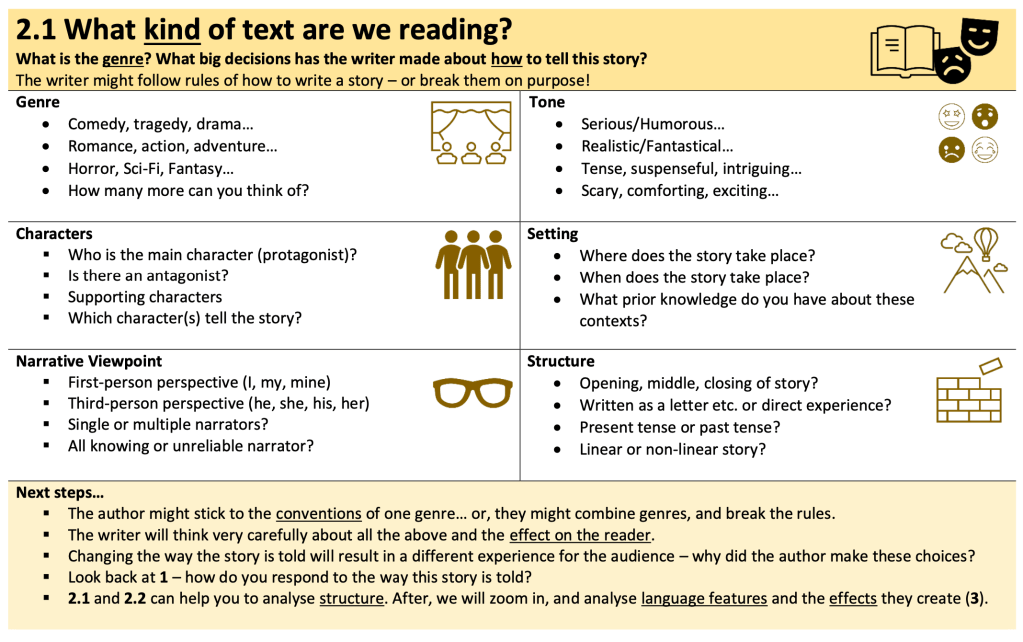
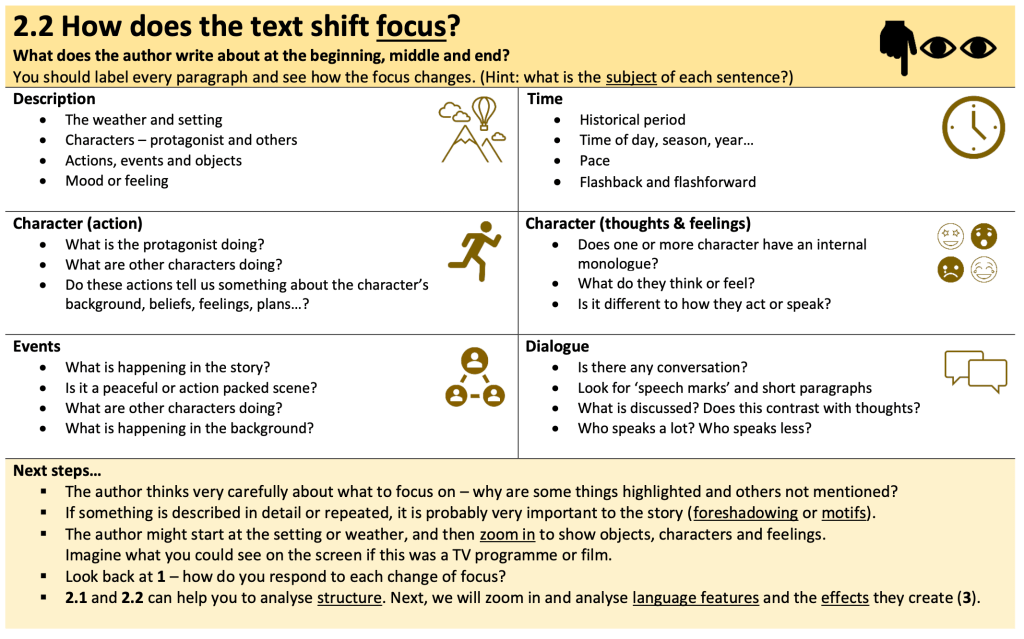
There are thousands of textbooks, websites and worksheets out there, and as teachers, we’re spoilt for choice – a choice that is often confusing and overwhelming. This is my attempt to make as few resources as possible: what is the minimum viable guidance that could be used alongside a text for a GCSE English learner?
Having taught in secondary schools, FE colleges and private tutoring, I’ve often found myself working in less than ideal situations. Schools and parents don’t always have access to resources, technology goes wrong, and learners don’t engage with the work. Last minute changes and adaptations are unavoidable. This resource can be ‘pulled out the bag’ when taking a struggling pupil out of class, or for a last minute cover lesson.
One way of bringing back disengaged learners is to personalise. Before working up to the sorts of extracts that feature in GCSE exams, it can be useful to use more appealing texts. This resource can be used as guidance to approach and analyse whatever text the teacher or learner brings to the classroom, even if there isn’t a worksheet or lesson plan to go alongside.
These resources are designed to act as prompts, fostering high-quality discussion between teacher and learners. The resource could work as a generic lesson plan for teachers, a reference mat for learners, or adapted as flash cards or posters.
The design of these resources is based on Oliver Caviglioli’s book ‘Dual Coding with Teachers’.
This set of resources is a work in progress, so any comments or criticisms are welcome. I’ve tried to strike a balance between plain English and subject terminology. A beginner and advanced version using each could be a useful future project.
Please download, use and share the PDFs. If you’d like the Word documents to amend, please contact me.
If you’ve found this resource useful, consider chipping in a couple of quid at Buy Me a Coffee.
— Advertisement —
 LPearceLearning